
When Medicare Part A Is Backdated 6 Months

A rule that catches HSA contributors off guard — and how to plan around it
INTRODUCTION
If you're enrolling in Medicare or Social Security retirement benefits after age 65, there's a quirky-but-important rule you need to understand: Medicare Part A is often backdated up to six months in the past. For most people this is harmless, but for anyone contributing to a Health Savings Account (HSA) it can create unexpected tax problems if you don't plan ahead.
This page explains the rule, walks through three scenarios that show how it plays out in different situations, and highlights the key thing HSA contributors need to watch out for. If you haven't already read our companion page on Medicare and Health Savings Accounts (gofouroaks.com/medicare-hsa), that's good background context for what follows.
The Rule in One Sentence
Medicare Part A is backdated up to six months from the month you submit your application for Medicare or Social Security benefits — but Part A will never start earlier than your 65th birthday month (or one month earlier if your birthday is the first of the month).

For Medicare's official explanation of when coverage can begin, see "When Does Medicare Coverage Start?" on Medicare.gov.
Three Scenarios That Show How It Works

To make this concrete, let's walk through three different situations using a hypothetical person we'll call Rachel, whose 65th birthday is April 20, 2026. In each scenario, the only thing that changes is when Rachel submits her application — and that's what determines whether (and how much) backdating happens.
Scenario 1 — No Backdating: Enrolling Before Your 65th Birthday Month
Rachel applies for Medicare a couple of months before her 65th birthday — let's say in February 2026.
Birthday: April 20, 2026
Application submitted: February 2026
Part A start date: April 1, 2026 (the 1st of her birthday month)
When you enroll before your 65th birthday month, Part A starts the first day of your birthday month — there's no backdating because there's nothing to backdate to. This is the cleanest scenario.
Note: this doesn't apply if you were already enrolled in Medicare Part A before age 65 due to receiving Social Security Disability (SSDI) benefits — that's a different situation.
Scenario 2 — Partial Backdating: Enrolling During or Within 6 Months After Your Birthday Month
Now suppose Rachel waits and enrolls in September 2026 — five months after her birthday month.
Birthday: April 20, 2026
Application submitted: September 2026
Six months back from submission: March 2026
Part A start date: April 1, 2026 (capped at her birthday month)
Counting six months back from September lands in March — but Part A can't start before Rachel's birthday month, so the backdating is capped at April 1. Rachel's Part A is backdated five months in this case.
If you enroll any time from your 65th birthday month through the six months that follow, Part A will backdate to the first of your birthday month. The exact amount of backdating ranges from one to six months depending on when you submit.
One important note for anyone who will owe a premium for Part A: if you (or your spouse) don't have the 40 quarters of work history needed for premium-free Part A, you can actually request that Part A not be backdated. It's a sensible move in this situation since the Part A premium is significant when you don't qualify for it for free, and there's no benefit to paying premiums for retroactive coverage you didn't use.
Scenario 3 — Full 6-Month Backdating: Enrolling More Than 6 Months After Your Birthday Month
This is the scenario that catches HSA contributors. Suppose Rachel never enrolls in any Medicare at age 65 because she's working for a large employer with creditable health coverage and contributing to an HSA. She plans to retire and start both Medicare and Social Security in April 2028, when she turns 67.
The standard advice is to submit the application about three months before you want benefits to start, so Rachel submits in January 2028.
Birthday: April 20, 2026 (she's now 67 in 2028)
Application submitted: January 2028
Six months back from submission: July 2027
Part A start date: July 1, 2027 (full 6-month backdating applies)
Because Rachel is well past the six-month window after her 65th birthday, her Part A gets backdated the full six months from when she submits. Her Part A start date ends up being July 1, 2027 — even though she intended her benefits to begin in April 2028.
Why the Backdating Matters for HSA Contributions
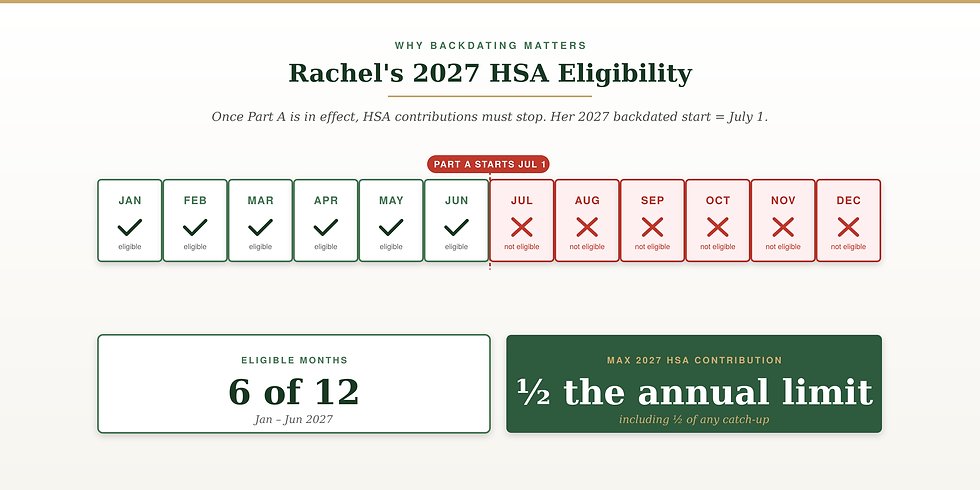
Once Medicare Part A is in effect, you can no longer contribute to an HSA — and the backdated start date is the date that counts, not the date you submitted your application. In Rachel's third scenario, her Part A was backdated to July 1, 2027.
That means for the 2027 tax year, Rachel was only HSA-eligible for January through June — six of the twelve months.
Her allowable HSA contribution for 2027 has to be pro-rated to 6/12 (or one-half) of the annual limit, including half of the $1,000 catch-up contribution if she's 55 or older.
If Rachel didn't realize this and contributed the full annual amount for 2027, she would have an excess contribution problem — subject to a 6% excise tax for each year the excess remains in the account, with the excess amount also losing its tax deduction.
The practical takeaway: if you're contributing to an HSA and planning to enroll in Medicare or Social Security more than six months after your 65th birthday month, account for the full six-month backdating before you finalize your HSA contributions. The simplest approach is to plan your HSA contributions assuming the worst-case backdating scenario — that way you don't end up needing to withdraw an over-contribution later.
Quick Reference: When Does Backdating Apply?
Enrolling before your 65th birthday month — No backdating. Part A starts the first of your birthday month.
Enrolling during or within 6 months after your 65th birthday month — Part A backdates to the first of your birthday month. Backdating ranges from 1 to 6 months.
Enrolling more than 6 months after your birthday month — Full 6-month backdating from the month you submit.
The single most important thing to remember: Part A backdating is calculated from the month you submit your application — not the month you want benefits to start. If you're submitting three months early to ensure timely processing (which is generally a good idea), your effective Part A date will be three months earlier than the start date you requested.
Helpful Reference Links
SSA.gov — Social Security Administration
Medicare and Health Savings Accounts (HSAs) — our companion page at gofouroaks.com/medicare-hsa
Have Questions?
If you have any questions about the information on this page, feel free to reach out — we're happy to help point you in the right direction.
(512) 298-5404 / gofouroaks.com



Comments