
Does Medicare Cover You When You Travel Outside the U.S.?


A clear guide to what Original Medicare, Medigap, and Medicare Advantage do and don't cover when you leave the country.
KEY POINTS AT A GLANCE — The Quick Version
✓ Original Medicare (Parts A & B) generally does NOT cover health care outside the U.S. — expect to pay 100% of foreign medical costs.
✓ Medigap plans C, D, F, G, M, and N include foreign travel emergency coverage: 80% of billed charges after a $250 deductible, up to a $50,000 lifetime maximum, during the first 60 days of a trip.
✓ Many Medicare Advantage plans offer worldwide emergency coverage, but the details vary by plan. Coverage is for emergencies only, and you can be disenrolled if you're outside your service area for more than 6 months.
✓ Medicare Part D plans do NOT cover prescriptions purchased outside the U.S.
✓ For longer trips or broader coverage, a dedicated travel insurance policy is often the smartest add-on.
INTRODUCTION
Original Medicare offers very limited coverage outside the United States. A Medicare Supplement (Medigap) plan with foreign travel emergency benefits or a Medicare Advantage plan with worldwide emergency coverage will fill most of the gap for short trips, and travel insurance can cover the rest.
If you're planning a cruise, a European vacation, or a visit to family abroad, this is one of the most important questions to answer before you go. Medicare's coverage outside the U.S. is narrower than most people assume, and what little coverage exists comes from a few specific places: certain Medigap plans that include foreign travel benefits, and the worldwide emergency provisions in many Medicare Advantage plans. This guide walks through each one in plain English so you'll know exactly where you stand before you book.
Original Medicare Abroad
Why Original Medicare alone won't help most travelers
For purposes of Medicare, "outside the U.S." means anywhere other than the 50 states, D.C., Puerto Rico, the U.S. Virgin Islands, Guam, American Samoa, and the Northern Mariana Islands. Once you're in any other country, Original Medicare (Parts A and B) generally won't pay anything for the care you receive.
There are a few rare exceptions — for example, a medical emergency in the U.S. when a foreign hospital happens to be closer, or traveling through Canada between Alaska and another state. These situations rarely come up for a typical traveler, so for planning purposes, it's safer to assume Original Medicare provides no coverage abroad. What actually matters for most people is whether they have a Medicare Supplement plan or a Medicare Advantage plan with foreign travel benefits — and that's where the next sections come in.
One last narrow exception that does come up: cruise ships. Original Medicare may cover medically necessary care on a cruise ship when the ship is in a U.S. port, or no more than 6 hours away from a U.S. port, at the time you receive care. Once the ship is more than 6 hours from a U.S. port, you're paying out of pocket — unless you have a Medigap or Medicare Advantage plan with foreign travel benefits.
MEDIGAP FOREIGN TRAVEL COVERAGE

How Medicare Supplement plans help with overseas emergencies
This is where most travelers actually get their foreign coverage. If you have Original Medicare paired with a Medicare Supplement (Medigap) plan — specifically Plans C, D, F, G, M, or N — you have a foreign travel emergency benefit built in. Here's how it works:
✓ The plan pays 80% of billed charges for medically necessary emergency care you receive outside the U.S.
✓ You first meet an annual $250 deductible for the year.
✓ Coverage applies during the first 60 days of your trip only.
✓ There's a $50,000 lifetime maximum across all your foreign travel emergency claims.
✓ It only kicks in for emergencies that Medicare itself doesn't otherwise cover.
If you have an older Plan E, H, I, or J — these aren't sold anymore, but you may still hold one if you bought it before June 1, 2010 — they also include foreign travel emergency coverage on the same terms.
The takeaway for international travelers: a Medigap plan with foreign travel benefits is a meaningful safety net for a typical vacation, but for longer trips, more expensive procedures, or evacuations, the $50,000 lifetime cap can get used up fast. That's where travel insurance comes in.
Medicare Advantage Abroad
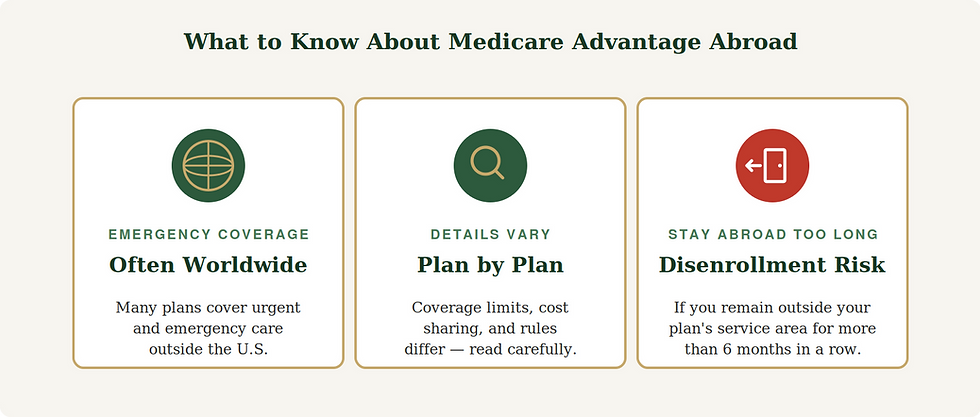
How Medicare Advantage plans handle international travel
If you have a Medicare Advantage (Part C) plan, your coverage outside the U.S. looks different. Most Medicare Advantage plans include a worldwide emergency benefit — meaning they'll cover emergency and urgent care wherever you happen to be — but the specifics vary widely. Some plans have higher cost-sharing for foreign emergencies; some require you to pay the foreign provider up front and submit for reimbursement when you return.
Two things to be aware of:
✓ Emergencies only. Worldwide coverage applies to emergency and urgent care. Routine doctor visits, planned procedures, or follow-up care abroad generally are not covered.
✓ The 6-month rule. Medicare Advantage plans are local — they have networks tied to a service area. If you remain outside that service area for more than 6 months, the plan may disenroll you and return you to Original Medicare.
If you're choosing between a Medigap plan and a Medicare Advantage plan and you travel internationally with any regularity, this is one of the things worth weighing. A Medigap plan with foreign travel benefits gives you a predictable, standardized benefit. A Medicare Advantage plan may be more generous in some cases and less in others — you need to read your specific plan's Evidence of Coverage to know.
Prescriptions and Filing Claims

Special situations: Part D and getting paid back by your plan
Prescription drugs. Medicare Part D plans do not cover prescriptions you fill outside the United States. Plan ahead: if you'll be traveling, check with your pharmacist about getting an early refill of any maintenance medications before you leave so you have enough to cover the whole trip.
Filing claims with your Medigap or Medicare Advantage plan. Foreign providers usually won't bill your plan directly — even when the care is covered. So in most cases, you'll need to pay the foreign provider in full at the time of service, save every receipt and itemized bill, and submit a claim to your plan after you return home to be reimbursed for the covered portion.
How it works depends on which plan you have:
✓ Medigap (Plans C, D, F, G, M, or N): Contact your Medigap carrier for their foreign travel claim form. You'll submit it along with your itemized bills and proof of payment. They reimburse 80% of billed charges for medically necessary emergency care, after your $250 annual deductible, up to the $50,000 lifetime maximum.
✓ Medicare Advantage: Contact your plan's member services line — most have a dedicated foreign claim or worldwide emergency claim process. Submit your itemized bills and proof of payment per their instructions. Reimbursement amounts and cost-sharing vary by plan.
The single most important habit while you're abroad: keep every receipt and ask for itemized bills in English when possible. Your plan can't reimburse without documentation, and getting bills translated and re-issued after the fact is far harder than asking up front.
CLOSING THE GAP
When travel insurance makes sense as an add-on
Because Medicare's foreign coverage is limited even with the best Medigap or Medicare Advantage plan, a dedicated travel insurance policy is often the smartest add-on for longer or more expensive trips. Travel insurance generally covers things Medicare and Medigap don't, including:
✓ Medical evacuation back to the U.S. (which can run $50,000 or more on its own) ✓ Routine and non-emergency care during your trip
✓ Care beyond your Medigap plan's 60-day window
✓ Coverage after your $50,000 Medigap lifetime maximum has been used up
✓ Trip cancellation, interruption, and lost-baggage protection

FREQUENTLY ASKED QUESTIONS
Quick answers to common questions
Q: Does Original Medicare cover medical care outside the United States?
A: Generally, no. Original Medicare (Part A and Part B) doesn't cover health care services received outside the U.S. and its territories, with three narrow exceptions involving foreign hospitals that happen to be closer than the nearest U.S. hospital that can treat you.
Q: Which Medigap plans include foreign travel coverage?
A: Plans C, D, F, G, M, and N all include the standard foreign travel emergency benefit: 80% of billed charges after a $250 annual deductible, up to a $50,000 lifetime maximum, during the first 60 days of a trip. Older Plans E, H, I, and J (no longer sold) also include this benefit if you bought one before June 1, 2010.
Q: Do Medicare Advantage plans cover care abroad?
Q: Does Medicare cover medical care on a cruise ship?
A: Yes, but only when the cruise ship is in a U.S. port or within 6 hours of one. Once the ship is more than 6 hours from a U.S. port, Medicare won't pay — though your Medigap or Medicare Advantage plan's foreign travel benefit may still apply.
Q: Will my Part D drug plan cover prescriptions I buy overseas?
A: No. Medicare Part D plans don't pay for prescriptions filled outside the United States. The best move is to refill any maintenance medications before you leave. Your pharmacy may be able to provide an early refill if you let them know you're traveling.
Q: How do I get reimbursed if I pay for care abroad?
A: For most travelers, the answer is to file a claim with your Medigap or Medicare Advantage plan when you return home. Foreign providers usually won't bill your plan directly, so pay the bill at the time of service, keep itemized receipts (in English if possible), and submit them to your plan's claims department for reimbursement under the foreign travel emergency benefit.
Q: If I live abroad full-time, can I still keep Medicare?
A: Yes, you can stay enrolled in Medicare while living abroad, but Medicare generally won't pay for care you receive there. You'll still pay your Part B premium each month. If you drop Part B while overseas and re-enroll later, you may face a late enrollment penalty. There's a Special Enrollment Period for people returning to the U.S. after working or volunteering abroad with qualifying coverage.
HAVE QUESTIONS? LET'S TALK.
Planning an international trip and want to be sure you have the right Medicare coverage in place? That's exactly what we're here for — and our help is always free.
📞 512-298-5404 ✉️ jwhite@gofouroaks.com
HELPFUL REFERENCE LINKS
Where to learn more
✓ Medicare's foreign coverage page: medicare.gov/coverage/travel-outside-the-u.s. ✓ CMS fact sheet on Medicare coverage outside the U.S. (CMS Product No. 11037): medicare.gov
Disclaimer
Four Oaks Medicare Planning is not connected with the Federal Medicare Program or the Social Security Administration.


Comments